2026 Dyslipidemia Guideline: What Has Changed in Cholesterol Management?
The 2026 Dyslipidemia Guideline represents a turning point that significantly changes the long-standing approach to cholesterol management. It is no longer considered sufficient to simply lower LDL cholesterol levels; rather, how early this reduction begins and how long it is maintained are now regarded as decisive factors in cardiovascular risk.
According to current guidelines, cholesterol management has evolved from a classical approach focused on a single laboratory value into a more holistic model aimed at reducing the patient’s total risk burden early and sustainably. This shift directly affects treatment strategies, especially for patients who have had a heart attack or belong to high-risk groups.
In clinical practice, more aggressive LDL targets, early combination therapies, and the evaluation of additional risk markers such as Lp(a) and ApoB are now coming to the forefront. This approach aims not only to correct numerical values but also to halt the atherosclerotic process at the earliest possible stage.
As observed in the interventional cardiology practice of Associate Professor Dr. Onur Taşar, the majority of cardiovascular diseases are the result of risk accumulation over years. Therefore, the core message of the new guideline is clear:
“The earlier the intervention, the more lives are saved.”
What Is the Most Important Change According to the 2026 Dyslipidemia Guideline?
According to the 2026 Dyslipidemia Guideline, the most important change is the shift in cholesterol management from focusing solely on LDL levels to the concept of “cumulative risk.”
In the new approach, the goal is not only to lower cholesterol but to initiate this reduction as early as possible and maintain it over a long period. Therefore, the fundamental principle of the guideline is summarized as:
“Lower, earlier, longer” (Triple L approach)
With This Paradigm Shift
LDL targets have become more aggressive
Early treatment initiation is recommended for high-risk patients
Combination therapies have become more prominent instead of single-drug treatments
New risk markers such as Lp(a) are more frequently incorporated into clinical decisions
From a clinical perspective, this change highlights that cardiovascular diseases should be managed not only based on the current condition but also according to the total accumulated risk over years.
In short: What matters now is not only how high cholesterol is, but how long it has been high.
What Is the Triple L Approach?
The Triple L approach is the core principle at the center of the 2026 Dyslipidemia Guideline and redefines cholesterol management.
Core Components
Lower: LDL cholesterol should be reduced to the lowest possible level
Earlier: Treatment should begin as early as possible, not after risk has already manifested
Longer: Achieved low LDL levels should be maintained over a long period
What Is Cumulative LDL Exposure?
One of the most important concepts of the new guideline is “cumulative LDL exposure.”
This concept refers not only to the current cholesterol level but also to the total LDL burden the vessels have been exposed to over the years.
Example
Moderately high LDL for 10 years
or very high LDL for 2 years
Both contribute to the formation of atherosclerotic plaques in the vessel wall.
Therefore, risk assessment has evolved from the question “What is the LDL today?” to “What has this vessel been exposed to over the years?”
Why Is Early Intervention Critical?
Atherosclerosis is not a sudden disease; it is a silent process that progresses over years.
Clinical Implications
Late treatment → cannot reverse accumulated damage
Early treatment → can slow or stop the process
“Lowering LDL is not enough; it is essential not to be late.”
Why Should Lp(a) Now Be Routinely Evaluated?
With the 2026 Dyslipidemia Guideline, Lipoprotein(a) [Lp(a)] is no longer considered an optional test but has been positioned as an independent cardiovascular risk factor.
What Is Lp(a)?
Lp(a) is an LDL-like lipoprotein, but due to the presence of apolipoprotein(a), it behaves differently from classical LDL.
Key Effects
It is more atherogenic
It accelerates plaque formation in vessel walls
It may increase the risk of thrombosis
Who Should Definitely Be Tested?
Individuals with early-onset heart attack
Those with a family history of early cardiovascular disease
Patients with persistent risk despite LDL control
Individuals with unexplained high cardiovascular risk
Why Is It Now So Important?
Lp(a) is genetically determined
It does not significantly decrease with lifestyle changes
It responds poorly to standard lipid therapies
Clinical Consequences
More aggressive LDL targets are set
Combination therapy is initiated earlier
Patients are monitored more closely
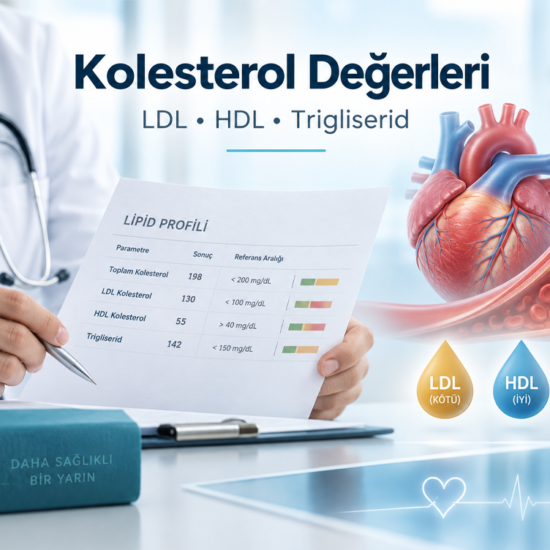
What Should LDL Targets Be According to the 2026 Guideline?
The approach is now clear: “The lower, the better — and as early as possible.”
LDL Targets by Risk Group
Low–moderate risk patients
LDL < 100 mg/dL
High-risk patients
LDL < 70 mg/dL
Very high-risk patients
LDL < 55 mg/dL
Extremely high-risk patients
LDL < 40 mg/dL
Who Is Considered Very High Risk?
Individuals with a history of heart attack
Those with stent or bypass history
Patients with diabetes and organ damage
Individuals with chronic kidney disease
Why Have Targets Been Lowered?
The lower the LDL → the slower plaque progression
Very low LDL levels → are safe
Aggressive reduction → reduces new event risk
Is Statin Alone Sufficient? The New Treatment Approach
Statin monotherapy is no longer considered sufficient for most patients.
Why Not?
LDL reduction may be limited
Targets may not be reached in high-risk patients
Delays increase cumulative risk
New Strategy: Early Combination Therapy
Combination therapy can be initiated early without waiting.
Common Combinations
Statin + Ezetimibe
Statin + Ezetimibe + PCSK9 inhibitor
When Should PCSK9 Inhibitors Be Considered?
If LDL targets are not achieved
If the patient is very high risk
If there is recurrent cardiovascular disease
Why Have ApoB and Non-HDL Become More Important?
Focusing only on LDL-C is no longer sufficient.
Why LDL Alone Is Not Enough
Measures only cholesterol amount
Does not reflect particle number
Can be misleading in high triglycerides
What Is ApoB?
ApoB represents the number of atherogenic particles.
LDL = cholesterol amount
ApoB = particle number
What Is Non-HDL?
Non-HDL = all atherogenic lipoproteins combined
Who Benefits Most from These Markers?
Patients with diabetes
Metabolic syndrome
Obesity
High triglycerides
Is Dyslipidemia Still a Standalone Disease?
Dyslipidemia is now considered part of a broader cardio-renal-metabolic system.
The Connection
Cardiovascular system
Metabolic system
Renal system
Why It Matters
These systems interact and amplify risk.
Clinical Meaning
Treatment must be systemic
Not limited to LDL alone
Why Are Obesity and Insulin Resistance Critical?
They:
Increase atherogenic particles
Raise triglycerides
Lower HDL
The Core Message: A New Paradigm
Cholesterol management is now about time and total risk.
Traditional vs New Approach
Traditional
Treat after LDL rises
New
Act early, treat aggressively, maintain long-term
Key Principles
Lower LDL as much as possible
Start early
Maintain long-term
Use combination therapy
Include additional markers
What Will Change in Clinical Practice?
Earlier treatment
More aggressive targets
More combination therapy
Deeper risk assessment
This leads to reduced heart attack and stroke risk.
Why Is This So Important?
Cardiovascular diseases:
Develop over years
Progress silently
Are often detected late
The goal is prevention before onset.
Is Your Cholesterol Really Under Control?
Normal values may not be sufficient.
Personalized Targets
Targets depend on individual risk.
Could You Have Hidden Risk?
Family history
Normal LDL but persistent risk
Diabetes or insulin resistance
Obesity
High Lp(a)
Is Your Treatment Really Sufficient?
Targets often not reached
Treatment may be delayed
Risk may be underestimated
Treatment should aim to minimize total risk.
What Should You Do?
If you are under treatment
If you are high risk
If you have family history
You should get a personalized risk assessment.
Frequently Asked Questions
What Should LDL Be?
Depends on risk level
Very high risk: <55 mg/dL
Extreme risk: <40 mg/dL
What Is Lp(a)?
A genetic lipoprotein increasing cardiovascular risk
Is Statin Enough?
Usually not in high-risk patients
Is Very Low LDL Harmful?
No, it is safe and beneficial
Why Is ApoB Important?
It reflects particle number
Can Risk Exist with Normal Cholesterol?
Yes, especially with Lp(a), diabetes, obesity, or family history