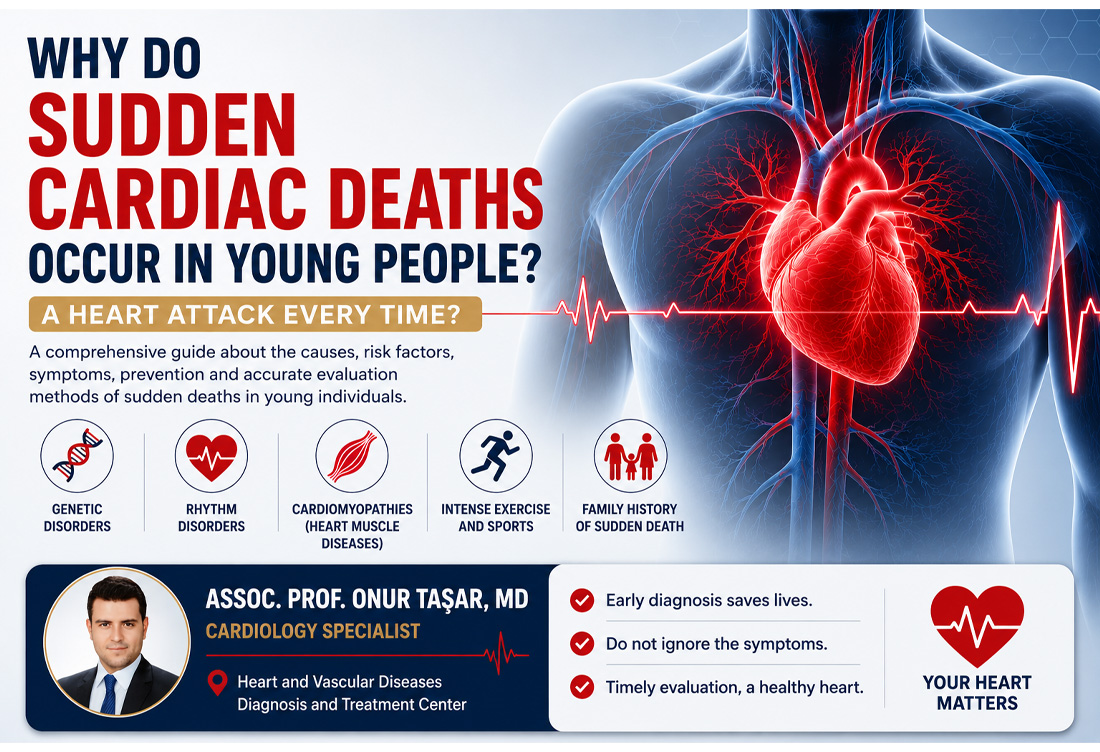
Sudden Cardiac Death in Young People vs Heart Attack Explained
When a young person dies unexpectedly, news reports often describe the event as a “heart attack.” From a medical perspective, however, this description is frequently inaccurate.
In individuals under the age of 35, a significant proportion of sudden deaths are not caused by the blockage of the coronary arteries, which is the underlying mechanism of a classic heart attack. Instead, they are most commonly the result of life-threatening cardiac arrhythmias—serious abnormalities in the heart’s electrical system that can cause the heart to stop beating effectively within seconds.
Understanding the difference between a heart attack (myocardial infarction) and sudden cardiac death (SCD) is essential for improving public awareness, enabling early diagnosis, identifying individuals at risk, and preventing potentially fatal outcomes.
A heart attack and sudden cardiac death are not the same condition. A heart attack occurs when blood flow to the heart muscle is interrupted due to a blocked coronary artery, leading to damage of the heart muscle. Sudden cardiac death, on the other hand, usually occurs when a severe electrical disturbance causes the heart to stop pumping blood effectively. This distinction is particularly important in young individuals, competitive athletes, and people with a family history of sudden cardiac death.
What Is Sudden Cardiac Death in Young People?
Sudden cardiac death (SCD) in young people refers to an unexpected death caused by a cardiac condition in an individual who previously appeared healthy or had never been diagnosed with heart disease. In medical literature, sudden cardiac death is generally defined as a natural death occurring within one hour of symptom onset, or within 24 hours after the person was last seen alive and well, when the cause is determined to be cardiac.
Although these events are commonly described as “heart attacks” by the general public, the most common cause of sudden cardiac death in people younger than 35 is not coronary artery disease. Instead, it is usually caused by malignant cardiac arrhythmias originating from abnormalities in the heart’s electrical conduction system.
When the heart loses its normal electrical rhythm, it may begin to beat in a rapid, chaotic, and ineffective manner rather than pumping blood normally. As a result, blood can no longer reach the brain and other vital organs. Without immediate medical intervention, death may occur within minutes.
Sudden cardiac death in young people can happen:
- During sports or intense physical activity
- While resting
- During sleep
- At any moment during normal daily life
For this reason, the risk is not limited to competitive athletes. Even young adults who appear completely healthy may have an undiagnosed inherited heart condition that places them at risk.
Many cases of sudden cardiac death are associated with underlying disorders such as:
- Inherited heart diseases
- Cardiomyopathies (diseases of the heart muscle)
- Congenital heart defects
- Genetic disorders affecting the heart’s electrical conduction system
Unfortunately, for some individuals, sudden cardiac death may be the first and only sign of an underlying heart condition. This is why regular cardiac evaluation is particularly important for people with a family history of sudden cardiac death at a young age.
Key Facts About Sudden Cardiac Death in Young People
- Most commonly affects individuals younger than 35 years of age.
- The leading cause is life-threatening cardiac arrhythmias, not blocked coronary arteries.
- Inherited heart diseases are among the most important risk factors.
- It may occur during exercise, at rest, or even during sleep.
- In some cases, early diagnosis and appropriate cardiac evaluation can significantly reduce the risk.
One of the most frequently misunderstood topics is the difference between a heart attack and sudden cardiac death. Although both involve the heart, they differ significantly in their underlying mechanisms, causes, clinical presentation, and treatment approaches.
What Is a Heart Attack?
A heart attack, medically known as myocardial infarction, is a serious cardiovascular condition that occurs when one of the coronary arteries supplying blood to the heart becomes suddenly blocked. As a result, the heart muscle is deprived of oxygen, leading to tissue damage. If blood flow is not restored promptly, the affected heart muscle may suffer irreversible injury.
The most common cause of a heart attack is atherosclerosis, a process in which cholesterol and other fatty substances gradually accumulate inside the coronary arteries over many years. These deposits form plaques that can rupture unexpectedly. When a plaque ruptures, a blood clot may develop and completely obstruct the artery, triggering a heart attack.
For this reason, heart attacks are generally the result of long-standing coronary artery disease and are more common in middle-aged and older adults. However, younger individuals may also experience a heart attack, particularly if they have significant risk factors such as smoking, diabetes, high blood pressure, elevated cholesterol levels, obesity, or a strong family history of cardiovascular disease.
It is important to remember that most cases of sudden cardiac death in young people are not caused by a classic heart attack, but by entirely different mechanisms involving inherited heart diseases or life-threatening cardiac arrhythmias.
Common Symptoms of a Heart Attack
Although symptoms can vary from one person to another, the most common signs of a heart attack include:
- Pressure, tightness, heaviness, or burning pain in the center of the chest
- Pain radiating to the left arm, shoulder, back, neck, or jaw
- Shortness of breath
- Cold sweating
- Nausea and vomiting
- Dizziness or feeling faint
- Weakness and unusual fatigue
In some individuals—particularly older adults and people with diabetes—symptoms may be less typical. Chest pain may be absent, and shortness of breath, profound fatigue, or generalized weakness may be the only warning signs.
Because early treatment is critical, anyone experiencing symptoms suggestive of a heart attack should seek immediate medical attention.
Can Young People Have a Heart Attack?
Yes. Although relatively uncommon, heart attacks can occur in young adults.
When a heart attack develops at a young age, it is usually associated with one or more of the following risk factors:
- Familial hypercholesterolemia (inherited high cholesterol)
- Smoking and tobacco use
- Diabetes
- Uncontrolled hypertension
- Obesity
- Substance abuse, particularly cocaine and amphetamine derivatives
- Rare congenital abnormalities of the coronary arteries
For this reason, it is incorrect to assume that every sudden death in a young person is caused by a heart attack. In many young individuals with no history of coronary artery disease, the underlying cause is more likely to be a life-threatening cardiac arrhythmia or an inherited heart condition affecting the heart’s electrical system.
What Is Sudden Cardiac Death?
Sudden cardiac death (SCD) is an unexpected loss of life that occurs when the heart can no longer pump blood effectively because of a severe disturbance in its electrical system. In most cases, it develops within seconds or minutes and can be fatal if immediate medical intervention is not provided.
The heart relies on a highly organized electrical conduction system to maintain a regular heartbeat. In a healthy heart, electrical impulses travel through specialized pathways in a coordinated sequence, allowing the heart muscle to contract efficiently and pump blood throughout the body. However, when this electrical system malfunctions, the heart may begin beating extremely fast, irregularly, or ineffectively.
Life-threatening arrhythmias such as ventricular tachycardia (VT) and ventricular fibrillation (VF) prevent the heart from pumping enough blood to the brain and other vital organs. As blood circulation suddenly stops, the individual may lose consciousness within seconds, followed by cardiac arrest.
For this reason, sudden cardiac death is most often caused by fatal cardiac arrhythmias rather than a heart attack. In younger individuals, many cases are linked to inherited disorders affecting the heart muscle or the cardiac electrical conduction system.
How Does Sudden Cardiac Death Occur?
Sudden cardiac death typically follows this sequence:
- A serious disturbance develops in the heart’s electrical conduction system.
- The heart can no longer contract effectively or pump blood.
- Blood flow to the brain stops abruptly.
- The individual loses consciousness within seconds.
- Without immediate intervention, irreversible organ damage and death may occur within minutes.
Unlike many chronic heart conditions that progress gradually, sudden cardiac death is an acute medical emergency that requires immediate treatment.
What Are the Symptoms of Sudden Cardiac Death?
Some individuals experience no warning signs before sudden cardiac death. However, the following symptoms may indicate an underlying serious heart condition:
- Unexplained fainting, particularly during or immediately after exercise
- Episodes of unexplained palpitations
- Chest pain or shortness of breath during physical activity
- Dizziness or lightheadedness
- A family history of sudden cardiac death at a young age
- Previous unexplained seizure-like episodes or transient loss of consciousness
Experiencing one or more of these symptoms does not necessarily mean sudden cardiac death will occur. However, when they develop—especially in children, adolescents, or young adults—they should prompt a comprehensive cardiac evaluation.
Can Sudden Cardiac Death Always Be Prevented?
Unfortunately, not every case of sudden cardiac death can be prevented. However, identifying individuals at increased risk, performing appropriate diagnostic testing, and initiating timely treatment can substantially reduce the likelihood of a fatal event.
A consultation with a cardiologist is strongly recommended in the following situations:
- A family history of sudden cardiac death before the age of 50
- Fainting or loss of consciousness during exercise
- Recurrent episodes of palpitations
- A diagnosis of congenital heart disease
- Suspicious findings identified during a pre-participation sports screening
To evaluate the risk of sudden cardiac death, cardiologists may recommend one or more of the following tests:
- Electrocardiogram (ECG)
- Echocardiography
- Holter ECG monitoring
- Exercise stress testing
- Cardiac magnetic resonance imaging (Cardiac MRI)
- Genetic testing, when clinically indicated
Differences Between a Heart Attack and Sudden Cardiac Death
A heart attack and sudden cardiac death are two distinct medical conditions that are often confused with one another. Although both involve the heart, they differ significantly in their underlying causes, mechanisms, symptoms, and treatment approaches.
A heart attack occurs when one or more of the coronary arteries become blocked, depriving the heart muscle of oxygen. In contrast, sudden cardiac death is usually caused by a severe disturbance in the heart’s electrical system, resulting in a life-threatening arrhythmia that prevents the heart from pumping blood effectively.
For this reason, it is inaccurate to describe every sudden death in a young person as a “heart attack.”
Comparison Between a Heart Attack and Sudden Cardiac Death
| Feature | Heart Attack (Myocardial Infarction) | Sudden Cardiac Death |
|---|---|---|
| Primary cause | Blockage of a coronary artery | Life-threatening cardiac arrhythmia |
| Main structure affected | Coronary arteries supplying the heart muscle | The heart’s electrical conduction system |
| Typical age group | More common in middle-aged and older adults | More common in young individuals and athletes |
| Onset | Usually develops over minutes to hours | Often develops within seconds |
| Most common symptoms | Chest pain, pressure, shortness of breath | Sudden loss of consciousness, absence of pulse, cessation of breathing |
| Underlying cause | Atherosclerosis and blood clot formation | Inherited heart diseases, cardiomyopathies, and electrical disorders |
| Treatment | Immediate restoration of blood flow (angioplasty, stenting, etc.) | Cardiopulmonary resuscitation (CPR), automated external defibrillator (AED), and advanced cardiac life support |
| Prevention | Controlling cardiovascular risk factors, maintaining a healthy lifestyle, and regular medical follow-up | Early identification of high-risk individuals, comprehensive cardiac evaluation, and condition-specific treatment when indicated |
Can a Heart Attack Lead to Sudden Cardiac Death?
Yes. Although heart attack and sudden cardiac death are different conditions, they can be closely related.
A large heart attack can damage the heart muscle to such an extent that it triggers life-threatening ventricular arrhythmias, particularly ventricular fibrillation (VF). When this occurs, the heart suddenly loses its ability to pump blood effectively, leading to sudden cardiac arrest, which may result in sudden cardiac death if immediate treatment is not provided.
However, this does not mean that every case of sudden cardiac death is caused by a heart attack. In younger individuals, inherited arrhythmia syndromes, cardiomyopathies, and congenital heart diseases are far more likely to be responsible and should always be considered during the diagnostic evaluation.
Why Is Accurate Terminology Important?
Confusing the terms “heart attack” and “sudden cardiac death” can lead to widespread misconceptions and may delay the identification of individuals who are genuinely at risk.
Understanding the true causes of sudden cardiac death in young people helps:
- Identify high-risk individuals before a life-threatening event occurs
- Ensure that family members undergo appropriate cardiac screening
- Improve the recognition of inherited cardiovascular disorders
- Highlight the importance of pre-participation cardiac screening for athletes
- Increase public awareness of potentially preventable cardiac conditions
For these reasons, determining the exact cause of an unexpected cardiac death requires a comprehensive evaluation that may include clinical assessment, cardiac imaging, review of the individual’s medical and family history, and, when appropriate, post-mortem examination.